Lash Training Manual Vs Video Lessons Only
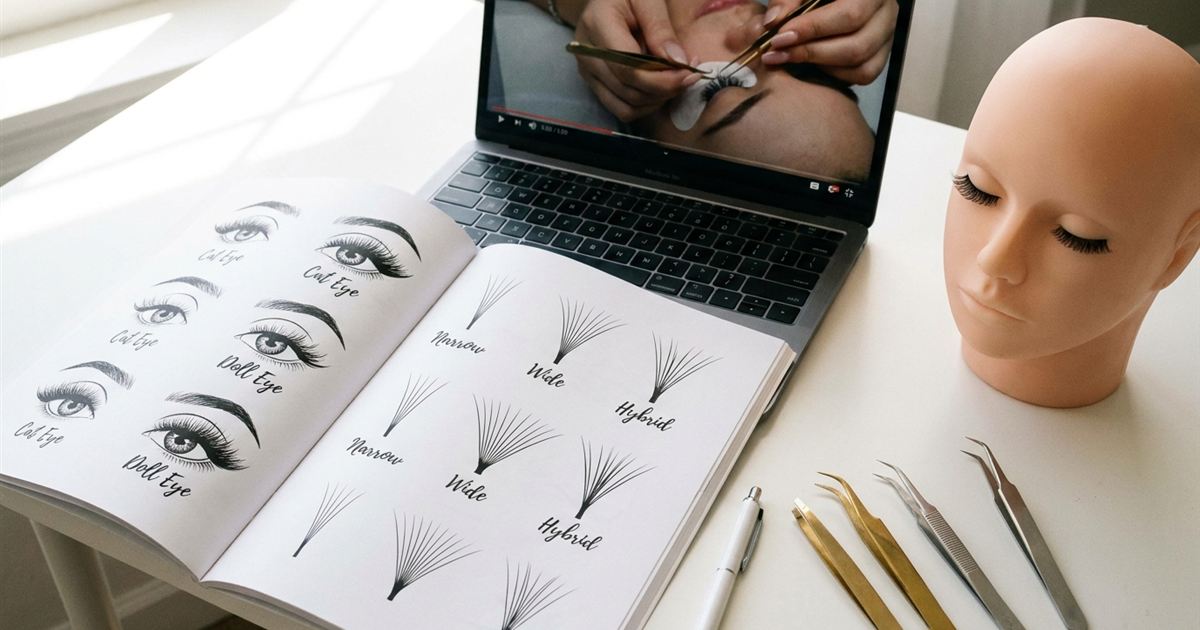
Most online lash courses sell themselves on video lessons, and rightly so. Watching a lash artist work is the closest thing to standing next to her. But if you have ever tried to find one specific detail in a long video, such as which curl works for a certain eye shape, or what the correct order of steps is, you know that video is not always the most convenient format. That is where a written training manual earns its place, and it is one of the most underrated parts of a good eyelash extension course.
Free Guide
Get Your Free Lash Extensions Starter Guide

A $17 value, yours free today. We'll send the guide straight to your inbox in the next minute.
You'll also get occasional lash tips by email. Unsubscribe anytime.
Videos teach you how a technique looks. A written manual gives you a quick reference you can check at your workstation, print, annotate and use long after you finish the course. The best programs offer both.
This guide explains what a lash training manual adds, what to look for in one and how to use it together with videos to learn faster.
Why Videos Alone Have Limits
Video is powerful for showing movement: how to hold the tweezers, how a lash is isolated, how an extension is placed. But it has several natural limits:
- It is hard to scan. You cannot skim a video the way you skim a page. Finding a specific step means scrubbing through footage.
- It needs a screen. When you practice, having a laptop or tablet next to your mannequin can be awkward.
- Details can be missed. A number, a name or an order of steps can pass by quickly.
- It is linear. You learn in the order the lessons are recorded, not always in the order your questions appear.
None of this makes video bad. It simply means video works best when it is supported by something you can read, check and write on.
What A Lash Training Manual Adds
A good manual covers exactly the gaps video leaves.
- A fast reference. You can look up a step in seconds instead of searching a video.
- A consistent structure. Steps are laid out in order, which helps you memorize them.
- Terminology. Lash work has many terms, from isolation to retention to mapping. A written glossary makes them familiar. For a start, see the eyelash extension terms glossary.
- Illustrations. Diagrams of lash mapping, fan shapes or eye anatomy can be easier to understand on a page.
- A place to write. Notes and practice records turn a passive reader into an active learner.
What To Look For In A Manual
Not every manual is equally useful. When a course advertises one, check that it is more than a short PDF of slides. A helpful manual should include:
- Step by step instructions for classic, hybrid and volume sets.
- Illustrations that make techniques and anatomy clear.
- Guidance on choosing curl, length and thickness, which connects to this lash curl, length and thickness guide.
- Aftercare and safety information you can share with clients.
- Practice tools, such as a homework template and a notes section.
- A clear layout that is comfortable to read on a phone and easy to print.
If a course promises a manual, ask how many pages it has and what it covers. Vague answers are a warning sign, and how to spot a fake lashing course lists other red flags.
How Videos And A Manual Work Together
The best way to learn is to combine both formats deliberately.
- Watch first. Use the video to see how the technique looks and moves.
- Read next. Open the manual for the same topic and follow the written steps.
- Practice with the manual open. Keep it beside your mannequin as a checklist, so you are not stopping to replay a video.
- Rewatch to fix problems. If something goes wrong, return to the video for the exact movement.
- Take notes in the manual. Write down what you learned and what surprised you.
This cycle of watching, reading and practicing helps knowledge stay in your memory much longer than watching alone.
Using A Homework Template To Track Progress
Practice is where lash skill grows, and many beginners practice without any record of what they did. A homework or practice template solves that. It gives you a simple structure to log each session:
- What skill you practiced, such as isolation, placement or adhesive control.
- How long you practiced.
- What went well and what went wrong.
- What you will focus on next time.
- A photo of the result, if possible.
After a few weeks, this record reveals patterns. You may notice that clumping happens when you rush, or that your outer corners are always less even than your center. That information is far more useful than a general feeling that you are improving. To build a practice routine, read how to practice lash extensions between lessons.
A Manual As A Reference When You Start Working
The value of a manual does not end when the course does. Once you begin working on models and clients, questions come up in the middle of an appointment or the night before. A manual gives you a quiet, reliable place to check.
- Before a consultation: review what to ask and what to explain. See what to ask in a lash client consultation.
- When choosing lash sizes: recheck the guidance on curls and lengths.
- When explaining aftercare: use the written rules to make sure you do not forget anything. Our guide on lash aftercare rules every client needs shows what to cover.
- When something goes wrong: revisit the steps before you try to fix a set. See lash correction: fixing bad sets.
Having answers on hand also builds your confidence, and confident artists tend to make calmer, safer decisions.
Print Or Digital: Which Format Is Better?
Both have advantages. A printed manual can sit next to your mannequin, gets covered in notes and does not depend on a battery. A digital manual is easy to search, lives on your phone and can go with you anywhere. Many students use both: digital for quick lookups, printed for practice sessions. If you plan to print, check that the layout works on standard paper and leaves room for notes.
Do Not Let A Manual Replace Practice
There is one trap worth naming. Reading a manual can feel like progress, and it is easy to keep studying instead of practicing. Knowledge is the map, but your hands still have to walk the route. Set a simple rule: for every hour of reading or watching, spend at least as much time with your tweezers. If shaky hands or hesitation hold you back, tips for shaky hands in eyelash extension training can help.
Common Mistakes When Using Course Materials
- Reading everything once and never returning. Manuals are meant to be reused.
- Skipping the notes section. Writing helps you remember.
- Ignoring the basics. Foundations such as isolation matter more than advanced styles. See beginner mistakes in eyelash extension training.
- Not printing or saving the manual. Keep it somewhere you can reach it quickly.
- Using a manual to skip supervision. It is a guide, not a replacement for getting feedback on your work, so learn how to verify your technique in an online lash course.
What Our Course Includes
The Lash Extensions Master Course comes with a 90+ page Classic, Hybrid and Volume Lash Training Manual, with illustrations, a student homework template and a notes section, included at no additional cost. It sits alongside 31 high quality video lessons you can rewatch with lifetime access, plus a Certificate of Completion, so you can learn by watching, reading and practicing in the way that suits you.
Final Thoughts
Videos show you the movement, and a manual gives you the reference. Together, they make learning faster, practice more organized and mistakes easier to fix. When you compare lash courses, do not stop at counting the videos. Ask what else the course gives you to study, practice and check when you are alone at your station. If you are still choosing, read how to choose a lash extensions course and what an eyelash extension training course actually includes.
Free Guide
Get Your Free Lash Extensions Starter Guide
A $17 value, yours free today. We'll send the guide straight to your inbox in the next minute.
You'll also get occasional lash tips by email. Unsubscribe anytime.
Frequently Asked Questions
Videos show you how a technique looks, while a manual gives you a fast written reference for steps, terms and measurements. Together they cover different ways of learning and different moments, such as practicing without a screen.
Keep Reading
Popular Lash Training Guides
- Minimum Age For Eyelash Extension Training
- Eyelash Extension Training Cost In 2026: Real Breakdown
- Lash Tech License Requirements By State
- Is It Hard To Learn Eyelash Extensions? Honest Answer
Ready to go from reading to doing? See the full Lash Extensions Master Course or browse all lash training guides.