Humidity and Lash Retention In Training
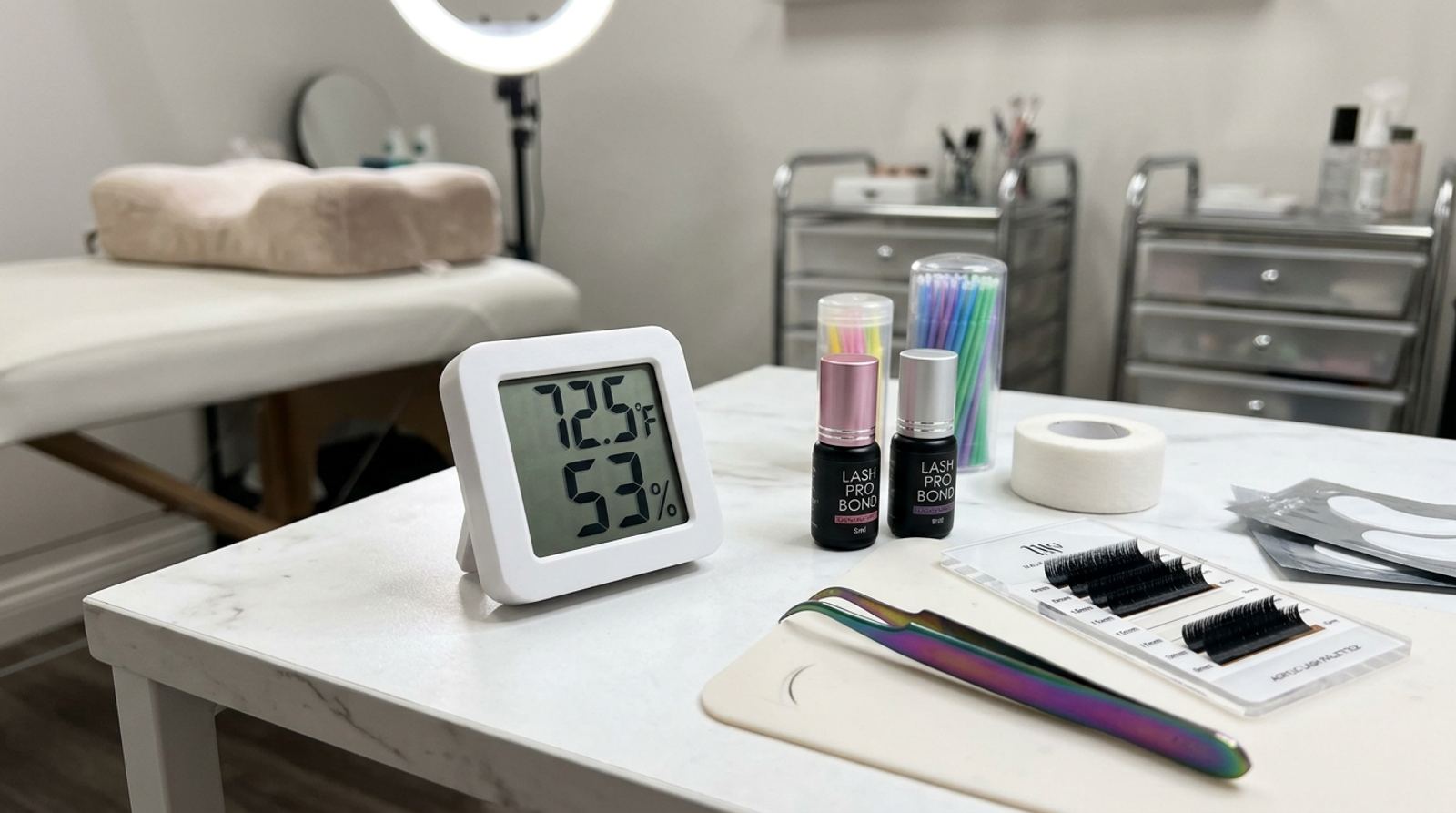
Two lash artists can use the exact same adhesive, the exact same technique, and get noticeably different retention results, and the difference often has nothing to do with skill at all. It’s the humidity in the room. This is one of those variables that’s easy to overlook when you’re focused on isolation and application, but it has a real, measurable effect on how well your work actually holds, and it’s worth understanding well before it becomes the mystery reason a client’s retention seems off.
Free Guide
Get Your Free Lash Extensions Starter Guide

A $17 value, yours free today. We'll send the guide straight to your inbox in the next minute.
You'll also get occasional lash tips by email. Unsubscribe anytime.
Why Humidity Affects Adhesive At All
Cyanoacrylate, the adhesive used in lash extensions, cures through a chemical reaction that specifically requires moisture in the air to complete properly. Too little humidity and the adhesive cures slowly and can end up brittle or under-cured, weakening the bond. Too much humidity and it can cure too fast, sometimes clouding (a visible white residue known as “frosting”) or bonding poorly because it sets before it’s had a chance to properly wrap the natural lash. Neither extreme is ideal, which is why most adhesives are formulated to perform best within a specific middle range rather than “more moisture is always better.”
Finding The Range Your Adhesive Actually Wants
Most cyanoacrylate lash adhesives perform best somewhere between roughly 40 and 60 percent relative humidity, but the exact range varies by product, so checking your specific adhesive’s packaging or manufacturer guidance matters more than memorizing one universal number.
Every adhesive brand and formula is slightly different, and manufacturers typically publish an ideal humidity and temperature range for their specific product. Rather than assuming all adhesives behave identically, get in the habit of checking this for whatever product you’re actually using, since switching adhesive brands without checking can mean you’re suddenly working outside the range you’d gotten used to with your previous product.
Working In A Naturally Dry Climate
If you live somewhere with consistently low humidity, indoor heating in winter, a naturally arid region, or an overly air-conditioned space, you may need to actively manage the environment rather than relying on ambient conditions. A small humidifier running in your workspace is the most direct fix, bringing the room closer to your adhesive’s ideal range regardless of what it’s doing outside. Some lash artists in dry climates also choose an adhesive specifically formulated to perform in lower humidity, which trades off some of the fastest cure times for more forgiving performance in drier air.
Working In A Naturally Humid Climate
The opposite problem shows up in consistently humid regions, where adhesive can cure faster than intended and be more prone to frosting or an incomplete bond from setting too quickly. A dehumidifier or simply working in an air-conditioned space helps bring humidity down into range. Some lash artists in humid climates also choose a slower-curing adhesive formula on purpose, to counteract the naturally fast cure their environment would otherwise produce.
Temperature Plays A Supporting Role Too
Humidity gets most of the attention, but temperature affects cure time as well, with cooler rooms generally slowing the cure and warmer rooms speeding it up, similar to the effect humidity has. The two interact, so a cold, dry room can compound into a particularly slow, difficult cure, while a warm, humid room can push adhesive toward curing too fast in the opposite direction. Most lash workspaces are already kept at a comfortable, consistent room temperature for client comfort anyway, which incidentally helps keep this second variable stable without needing to think about it separately from humidity.
Seasonal Shifts Matter Even If You Don’t Move
Even lash artists who never change location often see retention shift with the seasons, drier air in winter from indoor heating, more humidity in summer depending on the region. If you notice retention quietly getting worse or adhesive behaving differently at certain times of year without an obvious cause, checking whether the season has shifted your workspace humidity is one of the first things worth ruling out, well before assuming it’s a technique or product quality issue.
Adjusting Adhesive Amount, Not Just Waiting It Out
When you know you’re working outside a client’s ideal humidity range and can’t fully correct the room, a small technique adjustment helps too: being slightly more deliberate about adhesive amount and dip technique rather than rushing through application at your usual pace. Working a touch more carefully when conditions aren’t ideal, rather than sticking rigidly to your normal speed and hoping the adhesive performs the same as it always does, is a simple, practical adjustment that doesn’t require any new equipment or product.
Measuring Instead Of Guessing
A basic humidity monitor, inexpensive and simple to use, takes the guesswork out of this entirely. Rather than estimating “the air feels dry today” and hoping that’s accurate, an actual number lets you know exactly when you’re outside your adhesive’s ideal range and need to adjust, rather than discovering it only after a client comes back with disappointing retention and you’re left guessing at the cause after the fact.
If You Work Mobile Or Travel Between Locations
Lash artists who work mobile, traveling to a client’s home rather than a fixed studio, face a version of this problem that’s harder to control: every appointment location potentially has different humidity than the last. Bringing a small portable humidity monitor along, and knowing in advance how your adhesive tends to behave outside its ideal range, lets you make quick adjustments, working a bit faster or slower than usual, or bringing a backup adhesive formulated for a wider tolerance range, rather than being caught off guard by a client’s unusually dry or humid home on a given day.
Testing On A Lash Strip Before A Full Set In An Unfamiliar Environment
If you’re working somewhere unfamiliar, a new studio, a client’s home you haven’t lashed in before, or simply an unusually humid or dry day, a quick test bond on a spare lash strip before starting the actual set can tell you a lot. Watching how quickly the adhesive sets and whether it looks and feels normal gives you a preview of what to expect for the full application, and a chance to adjust your approach before you’re already partway through a client’s set and discovering the adhesive isn’t curing the way you expected.
How This Connects To What You Learned About Retention
Humidity is one variable among several that affect retention, alongside client aftercare, isolation quality, and adhesive application amount, and it’s rarely the only explanation when retention drops. But it’s one of the easiest variables to control once you know to look for it, and ruling it in or out early saves you from chasing the wrong fix, like assuming a technique problem when the real issue was simply an unusually dry week in your workspace.
What Our Course Includes
The Lash Extensions Master Course covers adhesives and retention as a dedicated part of the curriculum, alongside application and aftercare, for a one-time $97 payment with lifetime access, so you understand the “why” behind retention issues, not just the application steps.
Final Thoughts
Humidity is an invisible variable that has a very visible effect on your results, and understanding it turns a mysterious retention problem into something you can actually diagnose and adjust for. Know your adhesive’s ideal range, consider a humidity monitor for your workspace, and adjust your environment or product choice for your specific climate rather than assuming one setup works everywhere. For other retention factors worth ruling out, read how to fix poor lash retention, or see lash adhesive sensitivity and patch tests for how adhesive choice affects clients directly, not just your bond quality.
Free Guide
Get Your Free Lash Extensions Starter Guide
A $17 value, yours free today. We'll send the guide straight to your inbox in the next minute.
You'll also get occasional lash tips by email. Unsubscribe anytime.
Frequently Asked Questions
Cyanoacrylate lash adhesive cures through a reaction with moisture in the air, so the humidity level directly affects how fast and how completely the adhesive cures, which is why the same product and technique can perform differently from one room to the next.
Keep Reading
Popular Lash Training Guides
- Minimum Age For Eyelash Extension Training
- Eyelash Extension Training Cost In 2026: Real Breakdown
- Lash Tech License Requirements By State
- Is It Hard To Learn Eyelash Extensions? Honest Answer
Ready to go from reading to doing? See the full Lash Extensions Master Course or browse all lash training guides.