Does Your Course's Adhesive Brand Matter?
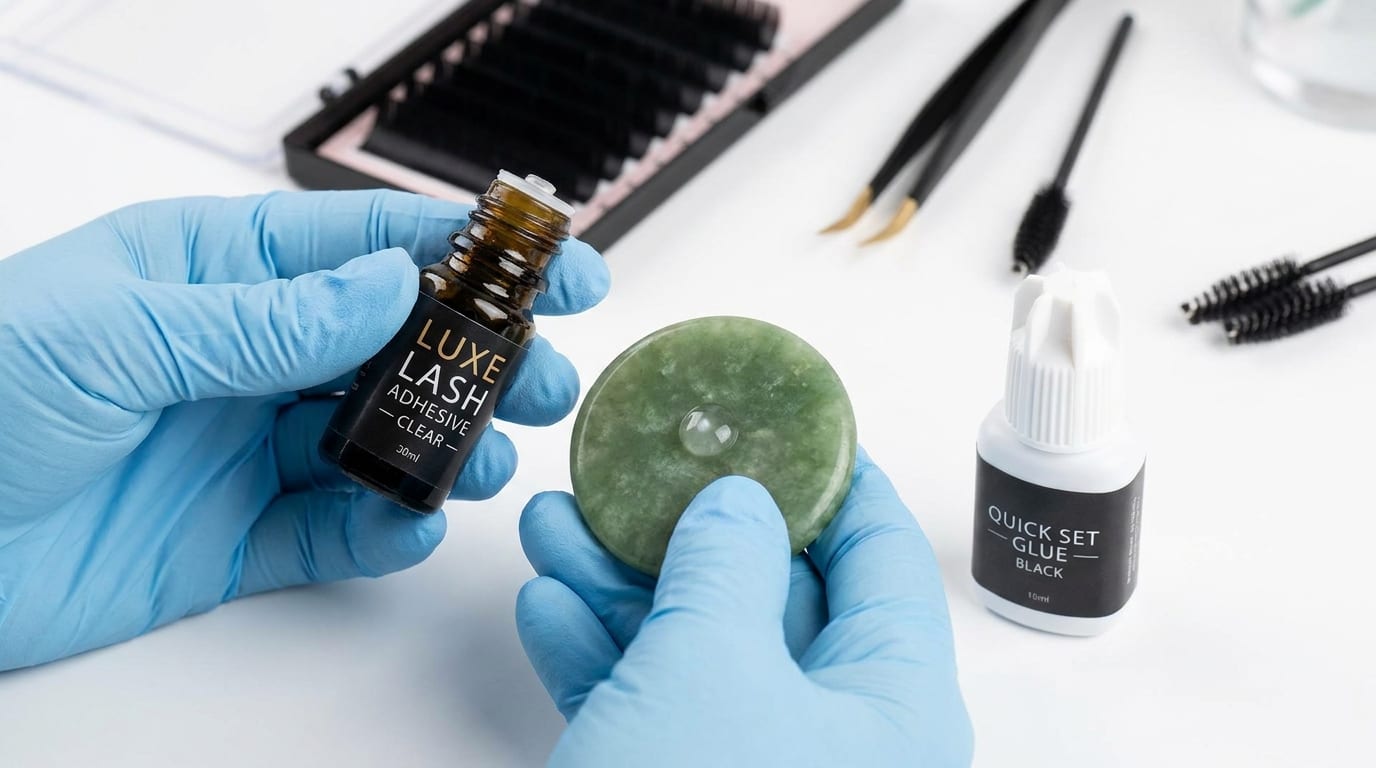
Almost every lash extensions course teaches on a specific adhesive brand, and it’s a fair question to ask before enrolling, or right after graduating, whether that brand choice actually matters once you’re out on your own. The short answer is that it matters far less than most new students assume: the adhesive your course used gets you comfortable with the fundamentals of bonding, retention, and working time, and switching brands afterward is a normal, manageable part of building your own practice.
Free Guide
Get Your Free Lash Extensions Starter Guide

A $17 value, yours free today. We'll send the guide straight to your inbox in the next minute.
You'll also get occasional lash tips by email. Unsubscribe anytime.
Why Courses Standardize On One Adhesive
The adhesive your course teaches on is chosen for classroom reliability, not because it’s the one true brand you’ll need for the rest of your career.
A classroom full of students practicing at the same time needs a dependable, consistent adhesive that behaves predictably under an instructor’s guidance, which is why most schools pick one trusted brand rather than letting each student bring whatever they found online. That consistency helps everyone learn the fundamentals, cure time, bonding strength, working time, without the added variable of comparing different products mid-lesson. It’s a teaching decision, not a signal that other adhesives are inferior or that you’re stuck with that one brand forever.
What Actually Transfers When You Switch Brands
The isolation technique, the angle you apply adhesive at, and your overall application rhythm all transfer directly to a new adhesive brand. What changes between brands is mostly working time, how long you have before the adhesive sets, viscosity, how thick or runny it feels on the applicator, and how it performs in different humidity and temperature conditions. Expect a short adjustment period, a few sets where the timing feels slightly different, rather than anything resembling relearning the skill from scratch.
Choosing Your Own Adhesive After Graduation
Once you’re building your own client base, the adhesive that makes sense for you depends on factors your course couldn’t fully account for: your specific workspace’s humidity and airflow, the climate you’re working in, how sensitive your typical clients turn out to be, and which set styles you find yourself doing most often. Rather than committing to a large bottle of something new sight unseen, buy a small size of one or two well-reviewed brands and genuinely test them on real sets before deciding what becomes your regular supply. Talk to other local lash artists in your specific climate too, since a brand that performs beautifully in a dry climate can behave very differently somewhere humid.
Why Some Artists Use More Than One Adhesive
Once you have more experience, you may find it useful to keep more than one adhesive on hand rather than relying on a single brand for every situation, a faster-setting option for sensitive clients who need shorter appointments, and a slightly slower one for detailed volume work where you want more control over placement before it bonds. This isn’t necessary for every lash artist, plenty run a full, successful business on one reliable adhesive, but knowing it’s a legitimate option helps you make the choice deliberately rather than assuming you must pick exactly one and never deviate.
Reading Retention Problems Correctly
If you start noticing more lash extensions falling out early after switching adhesive brands, don’t assume your technique suddenly got worse, check whether it’s actually a fit issue between the new adhesive and your workspace conditions or your client’s natural oil production first. Read how to fix poor lash retention for a fuller breakdown of the most common causes, since adhesive brand is only one variable among several that affect how long a set holds.
Sensitivity And Allergic Reactions Are Brand-Specific, Not Universal
A client, or even you as the technician, reacting to one adhesive brand doesn’t mean adhesive in general is off the table. Formulations vary enough between brands that a genuine sensitivity to one specific product often disappears entirely with a different one, which is worth knowing before ruling out lash work altogether over a single bad reaction. Always patch test a new adhesive brand on a client who’s had any prior sensitivity, the same way you would with your very first set on someone new.
Comparing Adhesive Brands Without Wasting Money
Rather than buying full-size bottles of several brands to compare, look first at what other lash artists in your specific climate are actually recommending, since working time and bonding behavior vary enormously between a humid coastal city and a dry, high-altitude one. Once you’ve narrowed it down to one or two candidates based on that local feedback, buy the smallest available size to test on a handful of real sets before committing to a larger, more cost-effective bottle. An adhesive that seemed promising on paper but doesn’t perform well in your actual working conditions is an expensive lesson to learn from a large bottle instead of a small one.
What To Ask A Course About Their Adhesive Choice
If you’re still deciding between lash extensions courses, it’s a reasonable question to ask directly why a particular school teaches on the adhesive brand it does, not to judge the answer harshly, but to understand whether it was chosen for genuine performance and reliability or simply because of a supplier partnership. Either reason can still result in a perfectly good learning experience, since the fundamentals you’re there to learn transfer regardless, but understanding the reasoning helps set realistic expectations about whether that specific brand is something you’ll want to keep buying long-term or simply a stepping stone for training.
Staying Current As Adhesive Formulas Change
Adhesive formulations do evolve over time as brands refine their products, so an adhesive that felt slow or finicky when you first tried it years into your career might have an updated formula worth revisiting. Staying loosely aware of what other lash artists in your networks are using and recommending, without chasing every new product that gets marketed to you, keeps you informed without constantly disrupting a supply chain that’s already working well for you.
Building A Relationship With A Supplier, Not Just A Product
Once you’ve settled on an adhesive that works well for you, it’s worth building an actual relationship with the supplier you buy it from, not just treating it as a one-off purchase, since suppliers can flag formula changes, batch issues, or storage recommendations that affect performance well before you’d notice on your own through trial and error. A supplier who knows you as a repeat, serious buyer is also more likely to give you an honest heads-up if something about a batch or shipping delay might affect your supply, rather than you finding out the hard way mid-appointment with a client already in your chair.
What Our Course Includes
The Lash Extensions Master Course teaches the fundamentals of adhesive control and bonding that transfer to any reputable brand you choose later, for a one-time $97 payment with lifetime access to revisit as your own practice evolves.
Final Thoughts
The adhesive brand your lash extensions course teaches on matters for getting you through training smoothly, but it isn’t a permanent commitment. Once you’re certified, choosing your own adhesive is just another normal business decision, informed by your workspace and client base rather than locked in by whatever your classroom happened to use. For more on building a reliable supply routine after graduating, see lash course supplies: the exact kit you need or monthly supply costs after a lash course.
Free Guide
Get Your Free Lash Extensions Starter Guide
A $17 value, yours free today. We'll send the guide straight to your inbox in the next minute.
You'll also get occasional lash tips by email. Unsubscribe anytime.
Frequently Asked Questions
No, once you're certified, you're free to buy and use whichever adhesive brand suits your working conditions, client base, and budget. The brand your course happened to use is a training choice, not a lifelong requirement.
Keep Reading
Popular Lash Training Guides
- Minimum Age For Eyelash Extension Training
- Eyelash Extension Training Cost In 2026: Real Breakdown
- Lash Tech License Requirements By State
- Is It Hard To Learn Eyelash Extensions? Honest Answer
Ready to go from reading to doing? See the full Lash Extensions Master Course or browse all lash training guides.