Is Lash Training Different for Lefties?
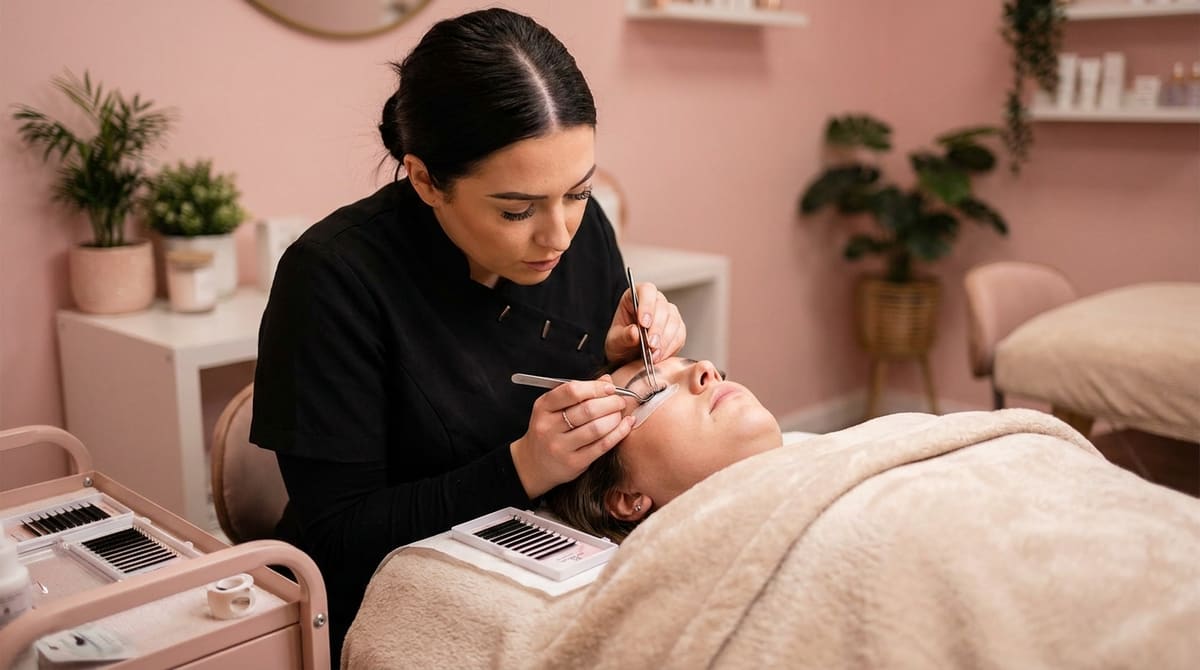
Watch enough eyelash extension course demo videos and you will notice a pattern: almost every instructor holds the isolation tweezer in their right hand and the application tweezer in their left, working from the same side of the client every single time.
If you are left-handed, that consistency can turn from “helpful repetition” into a quiet source of doubt: is the technique actually going to work the same way for you, or are you about to spend hours fighting a hand position that was never built with you in mind?
Free Guide
Get Your Free Lash Extensions Starter Guide

A $17 value, yours free today. We'll send the guide straight to your inbox in the next minute.
You'll also get occasional lash tips by email. Unsubscribe anytime.
The underlying technique does not change for left-handed students, but hand positioning and working angle often need a deliberate adaptation rather than a literal copy of right-handed footage.
Why Course Footage Skews One Direction
Most lash extension classes are filmed with a single instructor demonstrating on a single model, and if that instructor is right-handed (which most people are, simply by population averages), the footage naturally reflects a right-handed working position by default, not because the technique itself requires it. This is not a flaw in the course so much as a byproduct of who is doing the demonstrating, but it does mean left-handed students are quietly translating every hand position shown, whether the course acknowledges that or not.
What Actually Stays The Same
The core mechanics of lash application, isolating a single natural lash cleanly, controlling adhesive dip and placement, and building consistent tension in your working hand, do not depend on which hand happens to be dominant. A left-handed technician isolating with their non-dominant hand and applying with their dominant hand is following the exact same underlying logic as a right-handed technician doing the mirrored version. The skill is the skill. What changes is simply which hand does which job, and which side of the client’s face that puts you working from.
Where The Real Adjustment Happens
The genuine adaptation for a left-handed student is less about the tweezers themselves and more about physical setup: which side of the reclined client you position yourself on, how you angle your body and the client’s headrest, and which direction feels natural for your dominant hand to apply from without awkward crossing or twisting. Some left-handed technicians end up comfortably mirroring the entire setup (working from the opposite side of the client compared to a right-handed demo), while others find a hybrid position that works for their specific hand strength and habits. There is no single correct mirrored position, the goal is whatever setup lets you maintain a controlled, unstrained hand position for an entire appointment.
Real Scenario
A left-handed student in an online eyelash extension training course spent her first few practice sessions trying to copy her instructor’s hand position exactly, switching which hand held which tool to match the video. Her control was noticeably worse than during her very first attempt using her natural dominant hand for application. Once she gave herself permission to simply mirror the setup, dominant hand applying, positioned on the opposite side of the model compared to the demo, her control improved within a single practice session.
Why Forcing A Mismatch Slows You Down
Trying to force an identical hand position to right-handed footage, rather than adapting the underlying logic to your own dominant hand, tends to create exactly the kind of strain and inconsistency that makes early practice frustrating. Fine motor control depends heavily on using your naturally stronger, more coordinated hand for the more delicate task (typically application), and working against that just to visually match a video adds friction that has nothing to do with your actual skill level. This is a case where following the letter of the demonstration works against you, and understanding the reasoning behind the technique serves you better than literal imitation.
If you notice this friction early in a course, it is worth pausing on the specific lesson and deliberately working through the mirrored version slowly, rather than pushing forward at the course’s default pace while quietly compensating with a strained, unnatural grip. Left-handed students who address the mismatch head-on in their first few practice sessions tend to build clean, confident habits faster than those who spend weeks unconsciously fighting their own dominant hand before finally adapting.
None of this should discourage a left-handed student from choosing any particular course based on handedness alone. The gap here is small, well within what a self-aware student can adapt to on their own with a little extra thought, and it says far more about how course footage happens to get filmed than about whether the underlying skill is actually accessible to you. Plenty of working lash technicians today are left-handed, running full client books with the exact same consistency and quality as their right-handed peers, simply because they adapted their setup early instead of assuming the technique itself was somehow out of reach. The friction is real, but it is a solvable, well-understood one, not a genuine barrier to entry, and it should never be the reason a capable, motivated student talks herself out of a lash career she actually wants to build.
Tools Are Rarely The Real Issue
It is tempting to assume the fix for any left-handed friction is specialized left-handed tools, but in practice, most lash tweezers are symmetrical enough that handedness has little to do with which specific tool you can use. The exception is less about “left-handed tools” existing and more about ordinary variation in handle shape and grip texture that any technician, left or right-handed, might prefer once they have practiced with a few different options. Spending time and money hunting for tools marketed specifically as “for left-handed technicians” is usually less useful than simply testing a small range of standard tweezer shapes and picking whichever feels most stable and controlled in your own dominant hand.
Working With, Not Around, A Right-Handed Instructor
If you end up learning from a right-handed instructor, whether through recorded video or live coaching, the most useful approach is asking them to explain the underlying reasoning behind a hand position rather than asking them to somehow demonstrate a mirrored version they may not naturally do themselves. A good instructor can usually articulate why a particular angle or grip works (tension, visibility, control) in a way that translates cleanly to your mirrored setup, even if they cannot physically demonstrate it left-handed on the spot. This is a case where a course or mentor’s ability to explain the “why” behind technique, not just show the “what,” makes a real difference for how easily you can adapt it to your own dominant hand.
What To Ask Before You Enroll
If being left-handed is a real concern for you, it is worth asking any course you are considering whether they offer live coaching, a community, or direct instructor access where you can ask specifically about mirrored positioning, rather than relying solely on right-handed demo footage. This matters more for group versus private training formats, since a private or live-coached course gives you a real chance to get individual feedback on your own natural hand position, instead of trying to reverse-engineer everything from a video built around someone else’s dominant hand.
Free Guide
Get Your Free Lash Extensions Starter Guide
A $17 value, yours free today. We'll send the guide straight to your inbox in the next minute.
You'll also get occasional lash tips by email. Unsubscribe anytime.
Frequently Asked Questions
The core isolation and application principles stay the same, but hand positioning, working angle relative to the client's face, and which side of the client you naturally work from can differ from a right-handed demonstration.
Keep Reading
Popular Lash Training Guides
- Minimum Age For Eyelash Extension Training
- Eyelash Extension Training Cost In 2026: Real Breakdown
- Lash Tech License Requirements By State
- Is It Hard To Learn Eyelash Extensions? Honest Answer
Ready to go from reading to doing? See the full Lash Extensions Master Course or browse all lash training guides.